With such an expanding media and advertising empire, it's not surprising that companies have found new and improved ways to put advertisements into our everyday lives. Native advertisement is basically ads that have been strategically placed online and have been integrated into a normal online platform. For example, you could see "Sponsored by Forever 21" on a website that is designed for teens and people looking for clothes. These advertisements are placed in a website that targets their target audience. The above native advertisement is by Taco Bell and is placed in a BuzzFeed article. It is placed very naturally in an article that many people read for entertainment and looks like it's an unintentional part of the article. The audience that usually reads BuzzFeed is a young and new crowd that reads it for entertainment and has free time to sit in a computer. Taco Bell wants to target and new and fresh audience because most of their customers and young. The caption for the article reads, "Some things are meant to be kept for yourself, just like the new Taco Bell Loaded Grillers...". It seems so integrated in the article and like it's not even an advertisement. Because it's so naturally placed in the article, it becomes naturally placed in the readers mind and becomes a normal part of their life.The tone of it is very happy and friendly. It's almost as if the author is talking to the audience in a personal and friendly way, thus increasing the appeal of Taco Bell. The article is fun and entertaining, thus Taco Bell is fun and entertaining. Then it shows how the loaded grillers are 99 cents, also an appealing offer. It is all placed right above the article and so it is the first thing that people read and think about. This advertisement is clearly a native advertisement because not many people would consider it a "normal everyday advertisement" and would not ignore it like they would with any other advertisement.
Monday, December 15, 2014
Native Advertisement
With such an expanding media and advertising empire, it's not surprising that companies have found new and improved ways to put advertisements into our everyday lives. Native advertisement is basically ads that have been strategically placed online and have been integrated into a normal online platform. For example, you could see "Sponsored by Forever 21" on a website that is designed for teens and people looking for clothes. These advertisements are placed in a website that targets their target audience. The above native advertisement is by Taco Bell and is placed in a BuzzFeed article. It is placed very naturally in an article that many people read for entertainment and looks like it's an unintentional part of the article. The audience that usually reads BuzzFeed is a young and new crowd that reads it for entertainment and has free time to sit in a computer. Taco Bell wants to target and new and fresh audience because most of their customers and young. The caption for the article reads, "Some things are meant to be kept for yourself, just like the new Taco Bell Loaded Grillers...". It seems so integrated in the article and like it's not even an advertisement. Because it's so naturally placed in the article, it becomes naturally placed in the readers mind and becomes a normal part of their life.The tone of it is very happy and friendly. It's almost as if the author is talking to the audience in a personal and friendly way, thus increasing the appeal of Taco Bell. The article is fun and entertaining, thus Taco Bell is fun and entertaining. Then it shows how the loaded grillers are 99 cents, also an appealing offer. It is all placed right above the article and so it is the first thing that people read and think about. This advertisement is clearly a native advertisement because not many people would consider it a "normal everyday advertisement" and would not ignore it like they would with any other advertisement.
Generation Like
How powerful is the connection between the effect of social media
and the structure of the Hunger Games?
The
Hunger Games is a rising movie about a Utopian world that has annual
games with children being placed in a giant stadium by adults and having
to fight to death for entertainment. While it may be incredibly twisted, it is
regarded as “normal” in their community. With such an extreme and violent
ideology, it is surprising that many people have compared the Hunger Games with
social media today. Firstly, just like the Hunger Games, social media is
basically a big stadium with kids that is meant for entertainment. Each of
these kids are competing for the most “fame” or the most “likes”. Each person
in the Hunger and Games and in social media is looking for sponsors and looking
for people to accept them. Most of these social media outlets are made by
adults and always have a board of adults working the magic in the back, similar
to the game makers in the Hunger Games. Similar to the Hunger Games, the point
of social media is entertaining. But we as a society have invested so much time
and energy in it that it has become a normal part of society. Because social
media is integrated into our everyday lives, it is not often thought of as a
competition till death. But when you sit back and examine each detail, it is
shocking to see how much social media resembles a movie about competition and
death. Every little aspect of the Hunger Games can be related to social media
and that is eye opening.
Friday, December 12, 2014
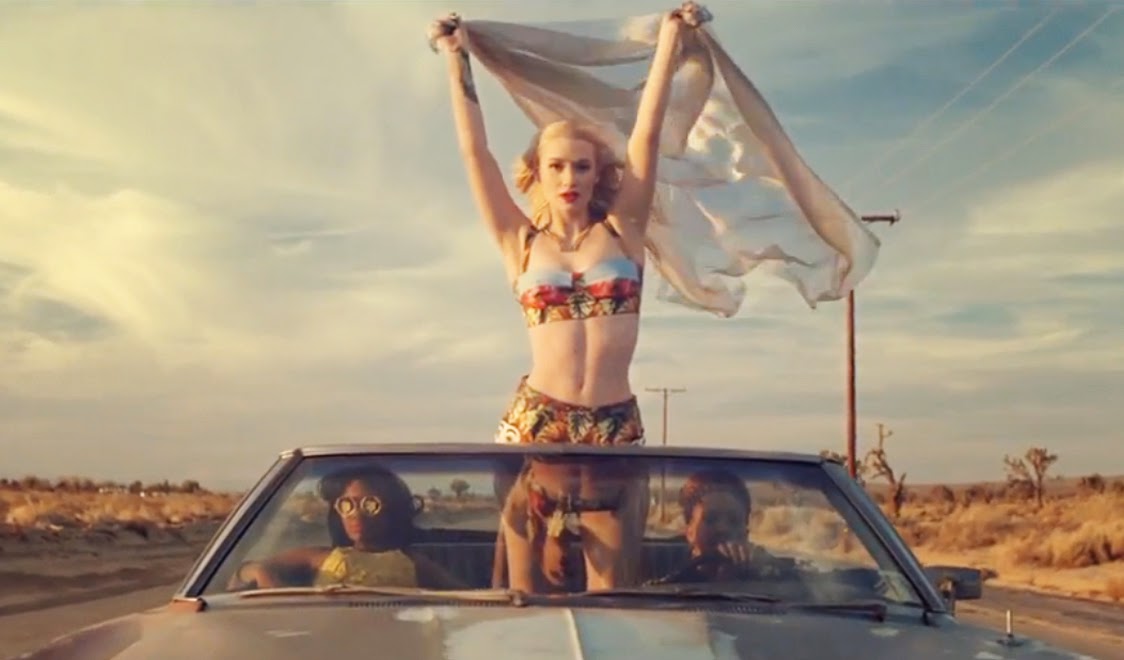
Iggy, Don't Forget Where you Came From
The new and upcoming star, Iggy Azalea, prides herself in the fact
that she came from a rough life and has made it big. In her song, “Work”, she
expresses the pride she has over her achievements in life. The song is filled
with powerful line such as “how many floors I had to scrub just to make it past
where I am from” or the reoccurring line of “no money, no family, 16 in the
middle of Miami”. The song is meant to show her struggles and to empower people
who are coming from several backgrounds to achieve their dreams. With such an
empowering message, it would be thought that the music video would put a tear
in your eye. The music video falls just shorts of that, seeing as Azalea
herself is wearing $2000 shoes and barely any clothing.
The opening scene begins with Azalea walking in a desert with
several objects on fire. The music video disappoints from the beginning considering
the fact that Azalea is barely dressed and wearing clothing that costs more
than most people’s homes, which is ironic considering the fact that she is
singing about the fact that she had nothing while growing up. The music video continues
to go downhill about 50 seconds in. Azalea is suddenly surrounded with backup
dancers who are shaking their butts in front of the camera while Azalea is
sexualizing herself because of the movements she is doing but also the clothing
she’s wearing. This lessens the value of the song and takes away from the
meaning. She is sexualizing and objectifying women, even though her song is
meant to be inspiring.
The real problem with the music video comes up about two minutes in
when Azalea begins dancing on a guy, steals his keys, and runs away. This is a
problem for two reasons. Firstly, it is disregarding the real message of the
song and making it seem like the only way she got to where she is is buy
seducing men and doing illegal things. Although her song is filled with lyrics
about her working hard, the music video makes it seem like the only way that
she becae successful was because of men and breaking the law. This brings up
the second problem: it marginalizes women everywhere because it shows that
women cannot be successful on their own and rather they have to seduce or trick
men in order to be up-and-coming.
Not only does this music video marginalizes women, it also goes on
to offend the impoverished people and their society. Azalea is seen riding in
her bike and walking around with clean clothing, full makeup, and nice hair in
neighborhoods with people who are wearing ripped and dirty clothes. She is
priding herself in coming from that background and yet in the music video, she
is walking around like she is better and more powerful than all of them. It
shows that she has clearly forgotten where she came from. It disrespects people
that are still living in impoverished situations and makes them seem like they
are worthless compared to people like her.
Although this song has a potential to be an empowering song, the
music video brings it back down to the norms of the music industry. Although
Azalea knows that she had a rough background, this music video proves that she
has succumbed to the lifestyle and the attitudes of the music industry.
Saturday, December 6, 2014
Written Task 2
Amirah Abualeez
Mr. Michael
Language and Literature HL
6 December 2014
How could the text be read and interpreted differently by two different readers?
Every
advertisement bases every single detail based on the target audience, yet some
advertisements can be multivocal and can give a different message to each
individual reader. American Apparel released an ad showing a pair of female
legs being held carelessly by a man. The only words that were placed were the company’s
logo in between the female’s legs. At first, because of the clear
objectification of the woman, the target audience may be blatantly assumed to
be men. In reality, though, this advert targets both men and women in very
different ways because it gives the men a very dominant and many vibe but it
also makes women feel as if their sole purpose is to please that man.
The
clear and unconcealed target audience of this ad are men. The advertisement
shows a man holding a woman by her feet as if they were toys. By showing only
one body part, it completely disregards the woman and focuses on the man in the
ad. The man is the dominant figure while the woman is the submissive figure. The
ad uses affect transfer because the men looking at this ad can get a very
dominant and manly vibe from the models and can transfer that vibe onto the
company and associate it with wearing their clothing. By having the woman being
held as if she was a toy, it shows the men looking at this advert that the main
purpose for women is to please men and that men can buy sex and women by buying
clothing from American Apparel. It gives men three things they want: women,
sex, and manliness. These are things that many men strive for and the company
has successfully been able to associate those three things with their company
in this one advertisement.
While
this advertisement seems to objectify, sexualize, and objectify women, women
can interpret this ad in one of two ways: either it offends them, or it
encourages them. Firstly, the logo of the company being placed in between the woman’s
legs further makes the woman look like a sex object. Because no other part of
her body is shown, the woman is objectified and made out to look worthless. Many
women will look at this ad and be offended because all women are made out to be
objectified as a result of this advert. On the other hand, this ad can directly
target women because it plays on many of their insecurities to sell. Just as it
shows the men that women are here to please them, it shows women the ways to
please men. Women will relate wearing American Apparel clothing with getting men’s
attention, something that many women strive for. They will relate beauty and
happiness with getting a man, which they will ultimately relate with the
company. This ad takes many women who feel negatively about themselves and
tries to portray this idea of being held by a man in a positive light. While
American Apparel is turning away many customers as a result of this
advertisement, it is also attracting and entire new audience.
This advertisement shows multivocality because it gives a dominant vibe to men but also plays on many women’s insecurities. Although completely unacceptable and appalling, this advert has a lot of potential for success. It captures attention and gets people to talk, and that is ultimately the purpose of this advert and many other American Apparel ads. American Apparel has not had a decline in their sales as a result of their overly risqué marketing techniques. They have strategically designed this ad in a way that reaches a variety of audiences and can be interpreted by each reader in a different way.
Tuesday, December 2, 2014
Further Oral Presenttion Reflection
FOA
Reflection
For
the first Further Oral Presentation, the possibilities were virtually endless. My
FOA analyzed how American Apparel, a clothing company, continuously used the
sexualization, objectification, and exploitation of women as an advertising technique.
American Apparel has hundreds of ads that focus on specific body parts, shows girls
in provocative positions, and does not bother censoring most of their
advertisements. The message that I was trying to get across with all this was
that these advertisements hold many unintended effects such as exposing women
to more violence, showing that women are only here to please men, and holding up
stereotypes about a women’s worth that have been prominent for centuries. I
decided to take a different approach when answering the unit question of, “what
does advertising reveal to us about society?” I decided to show many ads that
would make it seem like society is going nowhere, but in fact I believe that these
ads are the ones that show social progress because of all the controversy they
constantly receive. The four criterion that this FOA was graded on was Knowledge
and understanding of the text, organization, language, and understanding how
language is used. The main thing that I struggled with was being able to find
pictures that analyzed language well and being able to link the language with
my main topic question. I believe that I was able to use the language well and understand
that every sentence has a hidden meaning and I was able to communicate that
well. I do think that I could have talked about the language in relation to the
persuasive techniques we learned in class more (Ex: shock factor, pathos,
logos, etc). The techniques that I did discuss were affect transfer,
commodification of intimacy, ethos, logos, and I used trigger words several
times. With that being said, there were many instances where I could have used
them more effectively. Another weakness that I had was staying formal
throughout the entire presentation. There were many instances where I did not
use appropriate language or I could have been more formal with my wording. I
picked a topic that was tricky because it was time consuming to find ads that
incorporated enough language to analyze but was also school appropriate. I do
believe that one of my strengths was taking a different approach when answering
the unit question. Overall, I feel as if I had the potential to do a much
better job on my presentation but I am happy with the overall result. I feel as
if I did not say everything that I had intended to say but I also found myself saying
more things than I had written down. The message that I was trying to convey
was that American Apparel uses this exploitation of women to sell but it is not
completely accepted in society. I think I communicated this message
efficiently. Next time, I will make practicing my speech the main priority. I
found myself nervously looking down at my paper several times even though I knew
what I was supposed to say. I will also be aware of time constraints and have everything
I need to say in the required time. Overall, although I will set the bar higher
next time, I am proud of my work and how hard I worked on it.
Saturday, November 8, 2014
Advertisements and Culture
In
the early 2000’s, Olay came out with an ad that highlighted the important roles
of a woman: “wife”, “mother”, and “shoe aficionado”. These words were strategically placed next to
a seemingly glowing and happy woman who held up her wedding band in pride. The
close up shot of the woman allows the audience to place emphasis on her face
and to really feel like Olay has had a significant impact in her life, along
with shoes, of course. While the ad may be seemingly effective, it draws on
stereotypes that are prevalent in society today. According to this
advertisement, the only things that women value in life are the roles of being
a wife and a mother and meaningless things such as shoes. It indirectly states
that women do not have greater ambitions in life than being those things. It
places very low standards on women. At first, I assumed that this ad was in the
late 1950’s because that was a time where being a wife and a mother were the only important things for a
woman and they did not hold stable jobs or aspire to be something greater than
that. It was shocking to find out that it was actually from 2002 because that
proves that those sexist and stereotypical thoughts have carried on in society
today. Although it would be assumed that this ad aims to empower women, I would
argue that women are actually ignored and marginalized. The target audience is
the woman who is a housewife and who has free time to take care of herself. In
that sense, it ignores all the women who are not those things. It places a
generalization on women everywhere and actually insults the women who hold
stable careers and aspire to be more things. By placing the wedding band in the
picture, it shows that the woman values the fact that she is a wife. In my
opinion, that is empowering men because it shows that a women values a man in
her life and that men are one of the “important roles” that a woman plays.
Overall, this ad seems effective and friendly when someone first looks at it.
But right as you look closely and examine it more, it is clear that this ad
takes all of those existing stereotypes of women and plugs it into their in
order to sell more.
Sunday, November 2, 2014
Celebrities in Jail: Logos, Pathos, Ethos
Editorial
Do Celebrities get Special Treatment in Jail?
Amirah Abualeez
Robert
Downy Jr, Lindsay Lohan, Paris Hilton, Jay-Z, Lil Wayne, and many other
celebrities have served time in jail due to things such as drunk driving or
drug possession. It is not unusual to hear that a famous person has spent time in
jail, and then got out the next day. Many people start questioning the justice
system and accuse it of giving special treatment to celebrities and people in
high positions. In Pitkin County, Colorado, inmates are comfortable with a gym,
a dayroom, and balanced meals. When people celebrities read this, they automatically
assume that Charlie Sheen spends time in this jail because it is “comfortable”.
The reality is that, there are many inmates in that jail who are not. When it
comes to the justice system, the fancy and expensive attorneys cannot do much
when it comes to the actual jail stay. Celebrities do in fact get special
treatment, but special does not necessarily mean better.
To
begin, it is crucial to distinguish between a jail and a prison. A jail is
usually an open space where the inmates have activities and can interact with
one another. A prison is a closed off cell and the inmate has little
interaction with others. Prisons are usually for more serious crimes such as
murder and jails are for less serious crimes such as drunk driving, which is
where most of these celebrities fall into. Steve Whitmore of the Los Angeles
County Sheriff's Department states, “So if celebrities seem to have it easy in
jail, it's partly because the jail system is intended for nonviolent offenders
-- and celebrities usually fall into that class”. In a jail, it is the guard’s
jobs to reassure the prisoner’s safety. In the case of celebrities, there is a
very large chance that they could be harassed or even physically abused by
other prisoners. That is the reason that many celebrities end up having their
own cell isolated away from the rest of the prison, they are called “keepaways”.
When people look at one side of the story, they automatically assume that the
reason celebrities get their own cells is because they are being wrongfully
favored. In reality, these celebrities are constantly bombarded by the media
and do not get more privileges than many other people. Although some
celebrities get less time than they should, that is not a generalization that
can be made on all of them. Although Lindsay Lohan spent about 84 minutes in
jail in 2007, Robert Mitchum served his full sentence of 60 days, Robert Downy
Jr. and Lil Wayne spent a year in jail, and T.I. spent 10 months in jail. It is
so often that the experiences of certain celebrities such as Lindsay Lohan are
taken and then placed on other stars that had completely different experiences,
thus altering the views of society on the subject.
Today,
there are about 2.4 million people held in jails in the United States. Yet out
of those 2.4 million, it is only the incarcerated celebrities that attract
attention. Because of their lavish and upscale lifestyles, these celebrities
must also get lavish and upscale jail treatment, right? The answer is no. It is
generally assumed that these celebrities get special treatment because stories
like Lindsay Lohan’s infamous 84 minutes of Paris Hiltons 82 minutes in jail
surface the internet. The matter of the fact is that these celebrities do not
represent what actually happens to celebrities in jail. The “special”
privileges that they receive are not a matter of favoritism; they are a matter
of safety. The justice system will target anyone who has done wrongful acts, no
matter the size of their bank account. At the end of the day, jail is jail. These
celebrities will end up sleeping in the same bed that any other prisoner sleeps
in and they will eat the same food that any other prisoner will eat. With such
a growing media empire, it is vital to understand the entire picture and not
place generalizations on an entire group of people.
Subscribe to:
Posts (Atom)